
Start here
The quick answer: choose play, not pressure
For a four-year-old, a good game might mean turning over two bright cards and spotting a matching picture. For a teenager, it might be working out a logic grid. For a grandparent, it might be a relaxed round of word play or a strategy game shared with a child. None of these needs to be a test of intelligence. The point is to offer an interesting problem, a satisfying action and room to try again.
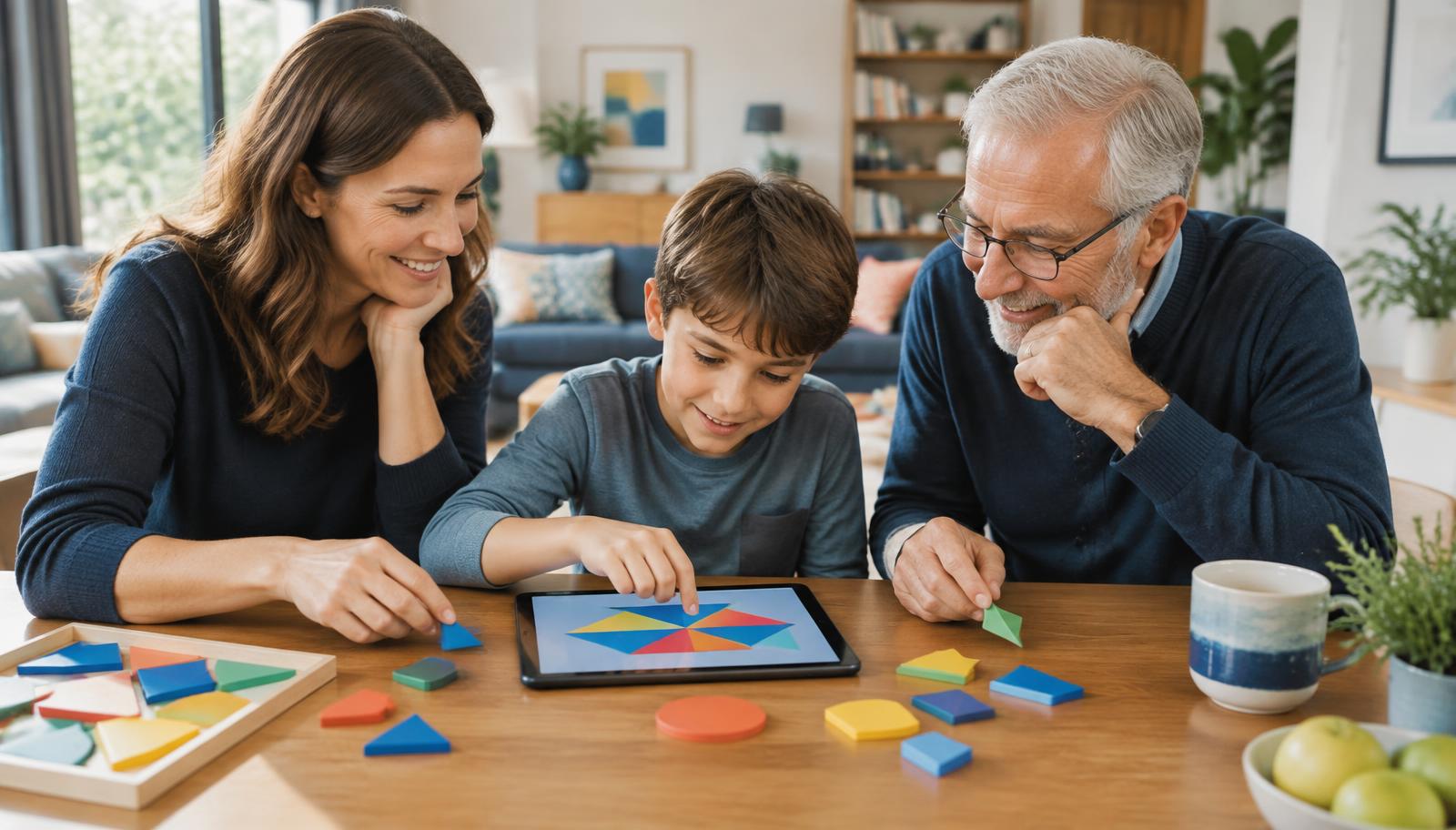
Start with a familiar interest. Like images? Try matching or visual puzzles. Enjoy language? Choose a word challenge. Prefer seeing a plan unfold? Try a strategy game. Then make the challenge comfortably achievable: enough to invite attention, not so hard that the player wants to stop after one turn. A short session that someone looks forward to is more useful than a long session they only tolerate.
MIND-IDIA has age-grouped games across memory, logic, vocabulary, mathematics, strategy and more. In the Game Hub, you can browse the games available to your profile. Your age group helps organize choices, but it is not a scorecard for what a person should be able to do. Interests, accessibility needs and previous experience matter just as much.
The visual guide
Start with what the player enjoys
Think of the diagram below as a menu, not a ladder. There is no required order or “best” category. A player can move between them from day to day. Each branch leads to a different kind of action: remembering, noticing, finding words, reasoning or planning ahead.
What sounds fun today?
Remember pictures
Memory Match · Turn cards, notice positions, find pairs.
Spot a pattern
Simon Pattern · Watch a sequence, then repeat it.
Play with words
Word Grid · Look for words among letters.
Work out a rule
Grid Logic · Use clues and remove possibilities.
Plan your next move
Connect Four · Take turns and look ahead.
If a player changes their mind halfway through, that is information, not failure. Notice which part was enjoyable: uncovering a pair, finding an unexpected word, or talking about what might happen next. Choose another game that offers more of that experience. In a family, different people can choose different games and still enjoy a shared conversation about their attempts.
See and remember
Memory games and patterns: simple rules, lots to notice
Memory Match: start with a few pairs
Memory Match is a classic picture-pair game: turn over two cards, remember what you have seen and look for a match. Its rules are easy to explain without a long tutorial. A younger child can take turns with an adult and say each picture aloud. An older player can keep an eye on where recently seen cards sit, try a larger set of pairs or play without hints from a partner.
A friendly way to play together is to take turns remembering aloud: “We saw the apple on the left.” That makes the process visible without treating a missed pair as a mistake. If a child guesses wildly, show how to pause and look at the board. If an adult gets one wrong, laugh and try again. The conversation is part of the experience, not an interruption to the game.
Simon Pattern: watch, replay, add one more
Simon Pattern asks players to watch a sequence and reproduce it. It suits someone who likes color and rhythm more than reading. On the first attempt, let the player learn what a single signal looks like. Then see whether a longer sequence still feels enjoyable. Saying a pattern aloud—“blue, green, blue”—can help some players follow along, while others prefer to focus silently. Neither style is the “right” one.
Remembering a game sequence is a specific play challenge. It should not be described as a measure of everyday memory or a way to diagnose changes in someone’s health. If you notice real-life memory concerns about yourself or someone else, ask an appropriate healthcare professional rather than interpreting a game score.
Slide Puzzle and Spot the Difference: different kinds of noticing
Slide Puzzle invites the player to rearrange pieces until an image is complete. It rewards patience and looking at the whole picture as well as the next move. Spot the Difference asks for careful comparisons between two pictures; it can be more enjoyable with a partner who sees the image differently. If visual detail is difficult to see, choose a different category rather than insisting that one format is suitable for everyone.
Say it, find it, learn it
Word and knowledge games without a classroom feeling
Word games are a good choice when someone enjoys names, stories, surprising facts or the small satisfaction of finding something hidden. In Word Grid, letters become a field of possibilities: look for a word, try another direction, then notice what you missed on your first scan. There is no need to rush. A child and a caregiver can search together, with the child choosing a starting letter and the adult joining the hunt.
For younger readers, choose a familiar word first. For older players, make a mini-challenge: identify three short words before searching for a longer one. If spelling is new or the person is playing in a second language, think aloud and celebrate discoveries without making the session feel like a lesson or a test. A word found by accident is still a discovery.
Vocabulary, spelling, language, science, history and general-knowledge categories offer other routes through learning. It can help to ask “What would you like to explore?” rather than “What should you know by now?” An adult may enjoy a quick history question more than a word grid; a teenager might prefer a strategy match over either. Choice matters at every age.
To keep a game social without open messaging, play side by side on the same device and talk in person. Ask each other why an answer seemed plausible, or invite someone to explain one unfamiliar term. The value here is curiosity and connection. A missed question is a chance to read an explanation, not evidence of a shortcoming.
Think a move ahead
Logic, estimation and strategy: different problems, different moods
Grid Logic and Balance Scale
Grid Logic asks you to fill squares without repeating items in a row, column or box. Start with what is already fixed. Look for a square with only one reasonable answer, then see what that rules out elsewhere. You do not need to solve the whole board in your head. A small step can make the next step visible; this is why a pause is often as useful as a quick guess.
Balance Scale takes another route to problem-solving: add weights until the two sides balance. The goal is immediately visible, which can suit a player who finds a long list of instructions tiring. Talk through one attempt—“What if we add this weight?”—and then test it. A wrong first choice is simply a clue about what to change on the next one.
Estimate It: compare your guess with the answer
Estimate It invites players to choose an approximate amount with a slider. It is not about producing a perfect number at speed. You can explain your guess to a family member before revealing the answer, then compare your reasoning with the result. With younger players, try asking whether the answer will be closer to the low end or high end. With older players, compare two estimation strategies and see which feels more useful.
Connect Four and Reversi: take turns, see what changes
Connect Four is an approachable strategy game: place discs in a column and try to connect four while watching what your opponent can do. Reversi adds another idea: placing one disc can flip others, changing the board in several directions at once. Both are available with a computer opponent or a person playing next to you on the same device where the game is offered to that age group. There is no public chat or stranger matching involved.
For a first round, a simple question is enough: “If I play here, what might the other player do next?” Let the player make the final move, even if you would choose differently. When the game ends, name one interesting turn rather than focusing entirely on who won. If someone prefers a calm solo puzzle, Grid Logic or Connect the Dots may be a better fit that day.
Find a fit
Eight age groups, many ways to play
Age groups help surface a comfortable starting point, not define a person’s abilities. MIND-IDIA uses four child groups and four groups under the Lifelong Learners umbrella for ages 18+. Availability of individual games differs by profile. Use the age-group selection as a guide, then let the person’s interest lead the choice.
Early Explorers 4–6
Shapes, colours, sounds and first letters. Start with memory or patterns, then follow curiosity.
Young Learners 7–9
Reading, numbers and curious questions. Start with vocabulary or mathematics, then follow curiosity.
Junior Thinkers 10–12
Puzzles that stretch reasoning. Start with logic or knowledge, then follow curiosity.
Teen Thinkers 13–17
Sharper challenges and real-world skills. Start with critical thinking or problem solving, then follow curiosity.
Young & Independent Learners 18–29
Build skills for study, work and life. Start with career skills or strategy, then follow curiosity.
Professional Learners 30–49
Focused challenges for busy minds. Start with problem solving or attention, then follow curiosity.
Experienced Learners 50–69
Rich puzzles and knowledge quests. Start with memory or general knowledge, then follow curiosity.
Lifelong Minds 70+
Engaging, relaxed-pace challenges. Start with memory or vocabulary, then follow curiosity.
For Early Explorers (4–6), begin with visual choices and play alongside an adult. Young Learners (7–9) may enjoy trying a word, number or color challenge and talking through what they see. Junior Thinkers (10–12) can often take more ownership of a puzzle’s rules and explain a move. Teen Thinkers (13–17) may prefer a strategy game or a real-world themed challenge over an activity that feels designed for younger children.
For Young & Independent Learners (18–29), a quick word or strategy round can offer a change of pace between everyday tasks. Professional Learners (30–49) might choose a compact problem-solving game that fits a busy day. Experienced Learners (50–69) can explore knowledge, vocabulary or memory games according to taste. Lifelong Minds (70+) can choose a relaxed-pace challenge, replay a familiar favorite and share it with another generation. No group needs to “keep up” with another one.
Make room for play
A short family routine that leaves room for life
A good routine does not have to be daily homework. Try choosing a regular, convenient moment when the player is interested: after a snack, before a family conversation, or on a quiet weekend afternoon. Start with one game. Decide in advance when to stop. At the end, ask a simple question such as “Which part did you like?” rather than demanding a higher score next time.
- Invite: Let the player choose between two different kinds of game, for example matching cards or a visual puzzle. Choice makes it more likely that the session feels like play.
- Set a boundary: For a child, the parent or guardian sets the daily limit. MIND-IDIA allows 15 to 180 minutes per day, with an absolute maximum of 180; that is a platform range, not a recommended amount of screen time. Choose what fits your family and follow professional guidance where relevant.
- Play: Let the person try a few rounds. Offer a clue when asked, not at every hesitation. If a puzzle becomes frustrating, step away or switch to another kind.
- Reflect: Talk about a surprising discovery or a move that changed the game. You do not need a printed chart or a reward for every attempt.
- Stop: Finish when the time boundary arrives or the fun runs out, whichever comes first. Make room for sleep, movement, offline play and time together.
The American Academy of Pediatrics’ Family Media Plan can help parents think through how media fits family routines. Its plan is not a universal timer to copy from someone else’s household. In MIND-IDIA, a parent can set and override a child’s play-time boundary; children do not get to override their parent’s settings.
If two people want to play together, consider a side-by-side game where both can see the board. Let a child explain a move to an adult, and let an adult admit when a child spots something first. Shared play can be a reason to talk, not a competition to rank family members by age or skill.
Honest expectations
What games can—and cannot—promise
Games can provide opportunities for cognitive engagement, learning through play, problem-solving practice and enjoyment. For young children, the National Association for the Education of Young Children describes how playful learning can involve active, meaningful experiences rather than passive instruction. That is a useful way to think about shared games: look for participation, conversation and discovery, not just a number on a screen.
That does not mean a game score can tell you someone’s IQ, diagnose memory concerns or guarantee gains in everyday cognitive ability. Practicing a particular game usually makes its rules more familiar; it does not prove broad transfer to unrelated tasks. Research in this area is nuanced, and claims of prevention or treatment require much stronger evidence than a fun activity can provide. The National Institute on Aging discusses cognitive health as a broader picture, not something a single game or app can settle.
MIND-IDIA is a place for learning and cognitive engagement for enjoyment. It is not a medical device, a treatment, a diagnosis or an educational qualification. Our scores and levels are game results, not clinical measurements. If you have a medical or developmental concern, seek advice from a qualified professional. For everyday play, the more useful question is simpler: was the game interesting, suitable and worth returning to?
Quick answers
Common questions before you start
What are good brain games for kids?
For children, start with clear rules, visual interaction and age-appropriate content. Picture matching, shape patterns, word finding and simple turn-taking are approachable options. A four-year-old and a twelve-year-old will not necessarily enjoy the same presentation; follow the child’s interest and play with them when appropriate. “Brain game” is a familiar search term, but it does not mean the game treats a condition or measures intelligence.
What are enjoyable brain games for adults and seniors?
Look beyond a single memory exercise. Word puzzles, picture matching, logic grids, estimation and turn-based strategy offer different kinds of engagement. For a person who likes social play, a same-device round of Connect Four may be more appealing than a solo timed challenge. Choose a pace, screen size and type of interaction that feels comfortable, and remember that enjoyment is a legitimate reason to play.
How long should someone play each day?
There is no one game-session length that suits everybody. Family schedules, energy, accessibility and other activities all matter. MIND-IDIA gives parents a way to choose a daily limit from 15 to 180 minutes for a child profile; 180 minutes is a maximum setting, not a goal. Begin with a short session and stop when it no longer feels worthwhile. Parents can use the AAP media-planning resource linked above to think about balance.
Can we play without competing with strangers?
Yes. MIND-IDIA includes solo games, games against a computer, and certain turn-based games for people sitting together and sharing one device. There is no unrestricted child-to-child messaging. An adult should supervise children and select an appropriate age profile. Different games appear for different age groups, so browse the Game Hub to see what is available for your account.
Do we need to know the rules before signing up?
No. Start with a game whose action sounds familiar: matching pictures, spotting a difference or dropping a disc into a column. Instructions appear with the games. It is fine to experiment and switch. New accounts have a three-day free trial without a card; continued access afterward requires a plan unless you have another valid access arrangement. The plans page has current prices for your country.
Further reading
Sources and useful context
These sources provide context for playful learning, cognitive health and family media choices. They do not endorse MIND-IDIA, and none is evidence that a specific game here produces a medical or cognitive outcome.
- NAEYC — The Power of Playful Learning
An overview of playful learning in early childhood and the value of meaningful interaction.
- National Institute on Aging — Cognitive Health and Older Adults
Evidence and cautions about activities, cognitive health and older adulthood.
- American Academy of Pediatrics — Family Media Plan
A tool for families to plan how and when children use media.
Your next move
Find a game that fits today.
Browse by age and interest, then choose a comfortable challenge. Try the games free for three days, no card needed; check the plans if you want to keep playing.
MIND-IDIA provides learning and cognitive engagement for enjoyment, not medical advice, diagnosis or treatment.